

ABA TherapyBlog

A token economy in ABA therapy is a structured reinforcement system where a child earns symbolic items called tokens for completing specific target behaviors, then exchanges those tokens for a preferred reward. Think Velcro stars on a clipboard, poker chips dropping into a jar, or check marks on a fridge chart. The framework was formalized in 1968 by psychologists Teodoro Ayllon and Nathan Azrin, and it remains one of the most evidence-backed teaching tools in modern behavior analysis.
What Is a Token Economy ABA, Exactly?
Every token economy has three working parts. The child earns tokens (conditioned reinforcers) for clearly defined behaviors. Those tokens, on their own, mean nothing, exactly like cash without a store. The child then trades a set number of tokens for a backup reinforcer: the actual reward they wanted, such as iPad time, a fruit snack, or a turn with a favorite toy.
According to a 2009 review by Travis Hackenberg in the Journal of the Experimental Analysis of Behavior, tokens work because they bridge the delay between effort and reward, keeping motivation steady through long teaching sessions.
The three pieces every system needs:
- Tokens — visible, countable items (stars, chips, points)
- Target behaviors — specific skills being taught (asking for help, completing a worksheet, sitting for circle time)
- Backup reinforcers — the actual rewards tokens “buy”
How a Token Board ABA Setup Looks in Practice
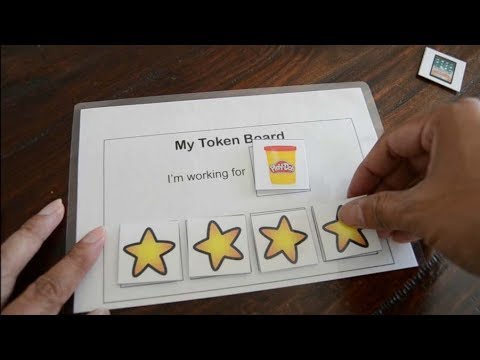
A token board ABA therapists use is usually a laminated card with 3 to 10 Velcro spots. As the child completes each step or trial, the therapist hands them a token to stick on the board. When the board fills, the child immediately gets their chosen reward.
The visual matters. A systematic review by Ivy and colleagues in Behavior Modification found that consistent visual presentation of tokens improved outcomes across studies involving children with autism.
Token economy examples shift with age and skill, but the structure stays the same:
- Early learner: 5 stars for sitting at the table = 2 minutes of bubbles
- School-age child: 10 points for finishing homework = 15 minutes of screen time
- Teen: a weekly chart where chores earn points redeemable for outings or video game time
A real-world scenario: A 6-year-old named Jordan refuses to brush his teeth. His therapist sets up a 4-spot token board. Toothpaste on brush, top teeth, bottom teeth, rinse, each step earns one token. Four tokens equal a dinosaur sticker. Within two weeks, the morning meltdowns dropped sharply.
Why Token Economy Autism Programs Stick
Token economy autism programs work because of what analysts call generalized conditioned reinforcement. Tokens get paired with many different rewards, so motivation holds even when one specific reward loses its shine. Matson and Boisjoli’s review in Research in Developmental Disabilities describes this flexibility as a core reason token systems outlast simpler reward setups for children with autism and intellectual disabilities.
The AFIRM modules at the University of North Carolina list reinforcement-based strategies, including token economies, among evidence-based practices for autism intervention.
Running a Reward System Autism Families Can Use at Home
A reward system autism parents can run at home does not need fancy materials. A magnet board, paper stars, or even a phone app does the job. Three rules keep it effective:
- Keep target behaviors specific and observable
- Deliver the token immediately after the behavior
- Honor the exchange every single time — no skipped rewards
Curious whether a token economy could click with your child’s specific goals? The behavior therapists at Epic Minds design reinforcement systems around what genuinely motivates your kid — favorite shows, specific toys, particular textures of snack — not a one-size template. Drop us a line and let’s sketch out a plan that earns its keep on your fridge.
Frequently Asked Questions
What is a token economy in ABA therapy?
A token economy in ABA therapy is a reinforcement system where a child earns tokens for specific behaviors and trades them for a preferred reward. It is one of the most studied behavior-change tools in applied behavior analysis.
How many tokens should a child earn before getting a reward?
Most therapists start with 3 to 5 tokens for younger children, then gradually increase the requirement as the child builds tolerance. The number depends on age, attention span, and motivation.
At what age can you start using a token board?
Token boards have been used effectively with children as young as 3, provided the child understands the link between tokens and the backup reward. Repeated pairing helps establish that connection.
Are token economies the same as bribes?
No. Bribes are offered in the moment to stop an unwanted behavior. Token economies are planned in advance to teach and reinforce specific target skills. The structure and timing make the difference.
Sources: