




ABA Therapy
The kitchen is one of the busiest, most rewarding rooms in a family’s life — and one of the most hazardous. For a child with autism, learning to navigate it safely is a milestone that unlocks real independence: making a snack, helping with meals, eventually preparing a simple breakfast on their own.
But getting there can feel daunting. Hot stoves, sharp knives, slippery floors, and unpredictable noise all live in the same small space. The good news is that kitchen safety is a teachable skill, and the same strategies that work in ABA therapy — visual supports, predictable routines, modeling, and reinforcement — work just as well at home. This guide walks parents through how to do it.
Why Kitchen Safety Matters Especially for Autistic Children
Children with autism often experience the kitchen differently than their neurotypical peers. Sensory sensitivities can make sizzling pans, beeping timers, and bright overhead lights overwhelming. Differences in attention and focus can make it harder to track multiple things at once — like a knife in one hand and a hot pan on the stove. And rigid routines, while a strength in many situations, can mean a child completes a familiar task on autopilot without noticing a new hazard.
These aren’t reasons to avoid the kitchen. They’re reasons to teach kitchen safety intentionally, in small steps, the same way you’d teach any other functional skill.
Start by Setting Up the Environment
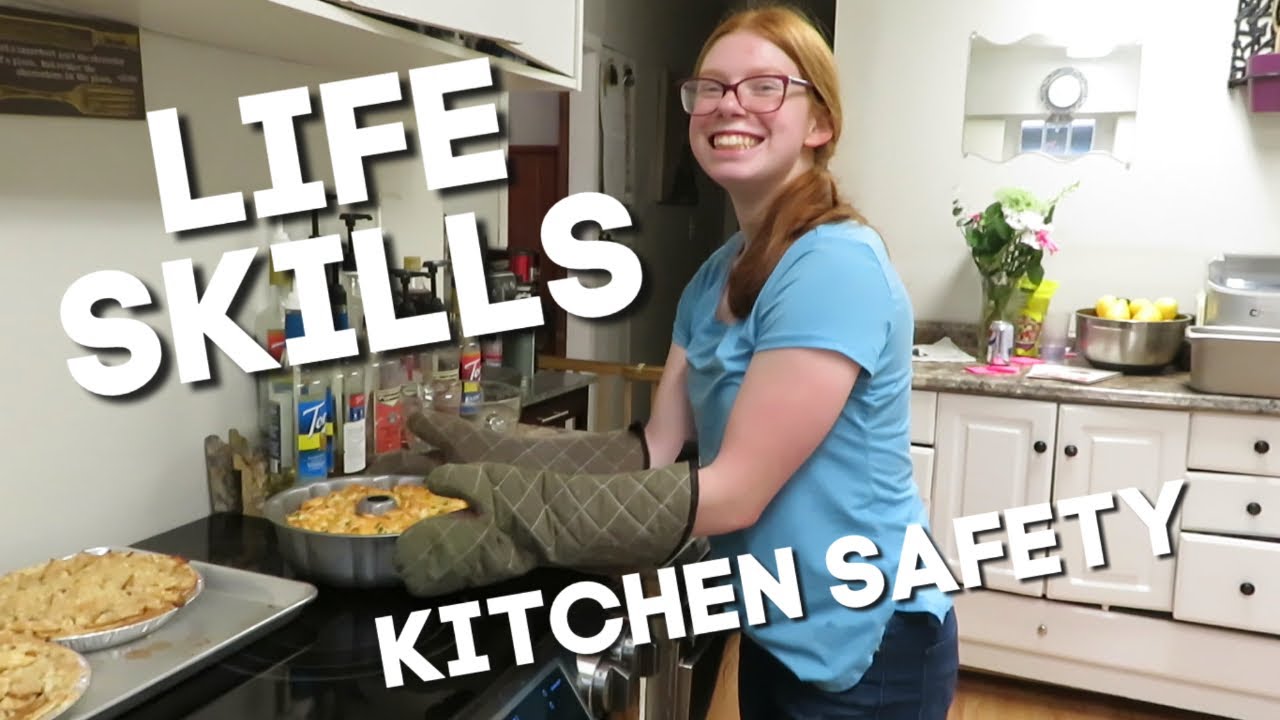
Before teaching a single rule, set the kitchen up to make safety the easier choice. Environmental setup does a lot of the work for you and reduces the number of decisions your child has to make at the moment.
A few high-impact changes:
- Move sharp knives out of reach until your child has demonstrated knife skills with supervision. Use a locked drawer or a high shelf.
- Use stove knob covers or a stove guard. Stove knobs are easy to bump accidentally, and a stove guard prevents pots from being pulled off the burner.
- Keep pot handles turned inward — toward the back of the stove — so they can’t be grabbed or knocked.
- Store cleaning chemicals locked or out of sight. A child following a recipe shouldn’t be able to grab the wrong bottle.
- Add non-slip mats near the sink and any spots that get wet. Slips are one of the most common kitchen accidents.
These adjustments aren’t permanent. As your child masters skills, you reintroduce items at appropriate stages — but you start by removing avoidable risks.
Teach Safety Rules with Visual Supports
Most autistic children are strong visual learners, so abstract rules (“be careful around the stove”) land far better when paired with visual supports. This is where ABA’s emphasis on visual learning pays off in real life.
A few visual support ideas that work well:
- Stop signs on dangerous items. A red stop sign taped to the oven, dishwasher, or knife block gives a clear “wait for help” cue.
- Picture-based safety rules posted on the fridge. Three to five rules max — washing hands, asking before using the stove, no running, etc.
- Color-coded zones. A green mat where your child is allowed to work, a red zone (the stove area) that’s adult-only until skills are demonstrated.
- Step-by-step recipe cards with pictures. Recipes broken into 5–8 visual steps make a complex task into a series of manageable ones.
Don’t try to teach all the rules at once. Start with two or three, master them, then add more.
Build Routines That Make Safety Predictable
Children with autism thrive on routine, and kitchen routines turn safety from an abstract concept into a series of expected steps. The classic four-part kitchen routine works well:
- Wash hands before touching food.
- Gather ingredients and tools — see what you need before you start.
- Cook — follow the recipe, one step at a time.
- Clean up — wipe surfaces, return ingredients, wash dishes.
Repeating this sequence every time creates a structure your child can rely on. After enough repetitions, the routine itself becomes a safety check — they notice when something is missing or out of order.
Model Safe Behavior, Then Hand It Over Gradually
Modeling is one of the most powerful teaching tools you have. Don’t just tell your child to wear oven mitts — put them on yourself, narrate what you’re doing, and show how you grip a hot pan. Then have them try it with an empty cool pan first.
A useful sequence many ABA therapists use is:
- You do, they watch. Demonstrate the skill while explaining each step.
- You do it together. Hand-over-hand or side-by-side, completing the step jointly.
- They do, you watch and guide. They take over while you stay close.
- They do it independently. Only after the previous stages are solid.
Each stage might take days or weeks. There’s no race — independence at a faster pace doesn’t mean independence at a safer level.
Start with Low-Risk Tasks First
Build the foundation before introducing higher-risk skills. A reasonable progression looks something like this:
Lowest risk first — washing fruit and vegetables, setting the table, stirring cold ingredients in a bowl, measuring dry ingredients, putting groceries away.
Medium risk — using the microwave with supervision, pouring liquids, using a butter knife on soft foods like bananas, loading the dishwasher.
Higher risk (only after skills below are solid) — using a sharp knife on stable foods, using the toaster, helping at the stove with adult side-by-side, using the oven.
A child who can confidently complete the lowest-risk tasks for several weeks has demonstrated the focus, sequencing, and rule-following needed to add the next layer. Skipping ahead because a task seems simple is where accidents happen.
Reinforce Effort and Safe Choices, Not Just Success
This is straight from ABA: reinforce effort, not just outcomes. When your child remembers to wash their hands before cooking, name it: “I noticed you washed your hands first. That’s exactly right.” When they ask for help instead of trying to use a sharp tool alone, that’s the moment to celebrate — they made the safe choice.
Positive reinforcement builds the habit of checking for safety, not just the memory of a single rule. That habit is what carries kitchen safety from a supervised activity into eventual independence.
Plan for Sensory Challenges
If your child is sensitive to noise, light, or smells, the kitchen can be sensory overload before any cooking starts. A few accommodations that help:
- Noise-canceling headphones for blender, mixer, or vent fan time.
- Cooking during quieter parts of the day — not when there’s a lot of family activity.
- Open a window or turn on the vent fan for strong-smelling foods.
- Dimmer lighting if possible, or work in a less brightly lit corner of the kitchen.
- Build in sensory breaks if a session runs long — 5 minutes of quiet between steps.
A child who’s sensorily overwhelmed isn’t safe in the kitchen, no matter how well they know the rules. Reducing sensory load is part of safety, not separate from it.
Teach What to Do When Something Goes Wrong
Even with great preparation, things will occasionally go wrong — a small spill, a dropped utensil, a forgotten step. Teach your child what to do before it happens, not in the moment:
- For spills: stop, tell an adult, don’t walk through it.
- For burns: run cool water over the area and tell an adult immediately.
- For cuts: put pressure on it with a clean towel and find an adult.
- For a fire on the stove: never use water; call for an adult right away.
Practice these scripts in a calm moment so your child has the language ready. For nonverbal children, picture cards or a communication device button for “I need help” works well — and the cards should be visible in the kitchen.
When ABA Therapy Can Help
If you’ve been working on kitchen safety at home and progress is slower than you’d like, an ABA team can break the skills down into smaller steps, run structured practice sessions, and use parent training so the strategies that work in therapy carry into your everyday routines. Functional skills like kitchen safety are exactly what good ABA does well — they’re practical, observable, and meaningful to a child’s independence.
For children who learn best through play and exploration, naturalistic strategies like Natural Environment Teaching can fold kitchen safety lessons into real cooking activities rather than separate drills. Either approach can be tailored to your child’s specific profile — that’s what an experienced BCBA will help figure out during an initial assessment.
The American Academy of Pediatrics also recommends safety teaching be integrated into a child’s everyday routines, not delivered as one-off lectures.
Conclusion
Teaching kitchen safety to a child with autism isn’t about turning your kitchen into a hazard-free zone — it’s about giving your child the skills, routines, and confidence to handle a real kitchen safely. With the right environmental setup, visual supports, predictable routines, and consistent reinforcement, the kitchen becomes one of the most rewarding places to build independence. Start small, go slow, and celebrate effort.
At Epic Minds Therapy, we help families across North Carolina — including Raleigh, Charlotte, Durham, Greensboro, Fayetteville, and surrounding communities — turn everyday routines into meaningful skill-building.
Our in-home ABA therapy brings expert support right into the spaces where life actually happens, including the kitchen, so your child can build functional skills in the environment that matters most.
If you’d like to learn how ABA could support your child’s kitchen safety and independence goals, contact Epic Minds Therapy today — we’d love to talk through what’s possible for your family.
Frequently Asked Questions
At what age should I start teaching kitchen safety to my autistic child?
There’s no single right age — it depends more on your child’s developmental stage, attention, and ability to follow simple rules than on a specific birthday. For most children, safety awareness can begin as young as 2–3 (“hot,” “ouch,” “stop”) and grow from there. The earlier you start with the lowest-risk tasks, the more time your child has to build the foundation.
My child gets overwhelmed by kitchen sounds. Should I avoid the kitchen entirely?
No — but adapt to the environment. Use noise-canceling headphones, cook during quieter parts of the day, and start with sensory-friendly tasks (washing fruit, stirring cold ingredients) before adding noisy ones (blenders, vent fans). The goal is gradual exposure with sensory accommodations, not avoidance.
What if my child loses focus mid-task?
This is common and worth planning for. Keep cooking sessions short — 10 to 15 minutes at first — and end before frustration sets in. Use visual checklists to mark progress so your child can see what’s done and what’s next. If a session unravels, that’s information for next time, not a failure.
How do I know if my child is ready for the next level of kitchen task?
Look for consistent rule-following at the current level over multiple sessions, the ability to ask for help when needed, and emotional regulation throughout the task. If those three are stable, you can introduce the next skill — with supervision and modeling, just like before.
Can I work on kitchen safety alongside other ABA goals?
Absolutely. Kitchen safety naturally pulls in communication (asking for help, naming tools), sequencing, fine motor skills, and self-regulation — all common ABA targets. A good BCBA can help integrate kitchen safety into your child’s existing goals so the work compounds.
Sources;
- https://pmc.ncbi.nlm.nih.gov/articles/PMC5256450/
- https://www.superhealthykids.com/kitchen-safety-rules-kids/